
Casino Sites That Accept Credit Cards in Australia
 Available in AU
Understand the difference between a casino accepting a card and the card issuer approving the transaction, plus how withdrawals are handled.

Table of Contents
- How Credit Card Casino Deposits Work for Australian Players
- Credit Card Casinos: What the Payment Route Actually Changes
- Casino Accounts With a Credit Card Deposit Option
- Credit Card Casino Deposits: Timing, Fees and Account Checks
- Other Payment Methods Used Alongside Credit Cards
- When an Online Casino Accepts a Credit Card but the Bank Does Not
- A Casino That Takes Credit Cards Still Needs a Withdrawal Plan
- Real-Money Casino Deposits: Cards, Bank Routes and Crypto
- Why Credit Card Cash-Outs Are Often Rerouted
- What Makes a Credit Card Casino Payment Setup Work
How Credit Card Casino Deposits Work for Australian Players
A credit card deposit starts with a simple chain: the player selects a card option at the casino cashier, enters the requested payment details, and authorises the transaction through the card issuer. The casino then credits the account when the payment is approved. That is the practical meaning behind phrases such as “online casino that accepts credit card”. The logo alone is not the whole process.
For Australian players, Visa and Mastercard are the main card networks encountered at casino cashiers. Their deposits are widely accepted and are described as instant, with processing commonly completed within seconds to minutes. The balance may therefore appear while the cashier page is still open, although the exact result depends on the casino’s payment integration and the card issuer’s decision.
The important distinction is between the casino displaying a method and the transaction being authorised. A casino may show Visa or Mastercard among its deposit options, while the issuer can still decline a particular payment. From the casino’s side, the route is available. From the bank’s side, that individual transaction may not be permitted. Those are separate stages, not contradictory statements.
This page highlights casino sites relevant to Australian players looking to use a credit card in 2026. Review each option’s available licensing, bonuses, deposit requirements, and payout details before choosing where to play.
License: Curacao eGaming Licence · Min. deposit: A$10 Aussie Play operates under a Curacao eGaming Licence and has a minimum deposit of A$10. It is a straightforward option for players looking for a low entry deposit.
License: Tobique Gaming Commission · Bonus: up to A$8,000 + 400 free spins across 4 deposits · Payout speed: crypto ~10-15 minutes, fiat 1-5 days · Min. deposit: A$30 SkyCrown holds a Tobique Gaming Commission licence and offers up to A$8,000 plus 400 free spins across four deposits. Crypto payouts are listed at around 10–15 minutes, while fiat payouts take 1–5 days.
Bonus: up to A$6,600 + up to 250 free spins across 4 deposits DragonSlots Casino stands out for a package offering up to A$6,600 and up to 250 free spins across four deposits. No licensing, deposit, or payout details are provided here.
License: Curacao (operating since 2017) · Bonus: 250% up to A$2,000 + 50 free spins on the first of six deposits · Min. deposit: A$20 Uptown Pokies has operated since 2017 under Curacao licensing. Its welcome offer is 250% up to A$2,000 plus 50 free spins on the first of six deposits, with a A$20 minimum deposit.
License: Curacao eGaming (Roby Games Ltd) · Bonus: 100% up to A$750 + 200 free spins Roby Casino operates under Curacao eGaming through Roby Games Ltd. It offers a 100% bonus up to A$750 together with 200 free spins.
License: Curacao eGaming Licence · Min. deposit: A$10 King Billy operates under a Curacao eGaming Licence and sets its minimum deposit at A$10. These are the main confirmed details available for this operator.
License: Curacao eGaming OGL/2023/174/0082 (Dama N.V.) · Bonus: up to A$10,000 + 500 free spins across 4 deposits · Min. deposit: A$15 LevelUp Casino holds Curacao eGaming licence OGL/2023/174/0082 through Dama N.V. Its promotion offers up to A$10,000 plus 500 free spins across four deposits, with a A$15 minimum deposit.
License: Curacao · Bonus: 100% up to A$500 + 200 free spins, 10x wagering · Payout speed: crypto 30-60 minutes, fiat 1-5 days · Min. deposit: A$10 Wild Tokyo is licensed in Curacao and offers a 100% bonus up to A$500 plus 200 free spins with 10x wagering. Crypto payouts are listed at 30–60 minutes, fiat payouts at 1–5 days, and the minimum deposit is A$10.
Bonus: 100% up to A$750 + 200 free spins, 35x wagering · Payout speed: crypto 30-120 minutes, fiat 24-72 hours · Min. deposit: A$30 MrPacho offers a 100% bonus up to A$750 plus 200 free spins with 35x wagering. Crypto payouts are listed at 30–120 minutes, fiat payouts at 24–72 hours, and the minimum deposit is A$30.
License: Curacao Gaming Control Board · Bonus: up to A$5,000 + 400 free spins JustCasino operates under the Curacao Gaming Control Board. Its promotion offers up to A$5,000 plus 400 free spins.
What a card deposit actually does
A casino deposit with credit card does not send money directly to a game. It first places funds into the casino account balance. Once the cashier confirms the payment, the balance becomes available under the account’s operating conditions. The card is the funding instrument; the casino account remains the place where the money is recorded and used.
The cashier normally asks for card information and the amount of the intended AUD deposit. It may also request an additional authorisation step from the issuer. The wording varies between operators, but the underlying action is the same: the card provider checks whether the transaction can proceed, and the casino waits for the payment response before crediting the balance.
This is why a “credit card casino site” should be assessed by the behaviour of its cashier rather than by a banner or payment logo. A genuine card route should allow a card-network option to be selected, present a transaction form, and return a clear approval or rejection message. If the option disappears at the final stage, the logo was not proof of a usable deposit route.
Visa and Mastercard are treated differently from less widely supported networks because their acceptance is broader. That does not mean every card, issuer or transaction will work. It means the network itself is commonly integrated into casino payment systems. For a player comparing casinos that accept credit card, network support is the first mechanical check, not a guarantee of approval.

The account name matters from the start
The payment method must be held in the same name as the casino account. This is not a cosmetic matching exercise. A deposit made with another person’s card can create a payment-ownership problem even when the card transaction itself is approved.
The spelling on the AUD99 profile, the bank account and the identification document should match. That requirement matters when the casino links the deposit to the account holder. A card belonging to a partner, relative or friend may therefore be unusable for the account, regardless of whether the cashier accepts the card number.
The cleanest arrangement is straightforward: the casino account is opened in the player’s legal name, and the credit card used for the deposit carries the same name. Keeping those details aligned avoids turning a successful payment into an account question later. It also gives the casino a consistent record of who funded the balance.
American Express is a narrower route
American Express can be used for an online casino deposit with credit card when the casino supports it. In that situation, the deposit is credited instantly and processed within seconds or a few minutes. The timing is therefore comparable to other supported card deposits at the transaction stage.
The limitation is availability. American Express is accepted by fewer casinos than Visa or Mastercard and is less widely accepted overall. A cashier may therefore support cards in general while excluding Amex specifically. “Cards accepted” is not precise enough; the relevant question is which network appears as an active option when the deposit is made.
Issuer Blocking American Express deposits may be blocked by the card issuer due to default gambling blocks on Australian-issued cards.
There is also an Australian issuer issue. American Express deposits may be blocked by the card issuer, particularly because gambling blocks may be enabled by default on Australian-issued cards. A rejected Amex payment can therefore reflect the issuer’s controls rather than a missing casino payment facility.
That distinction matters when reading claims about the best online casinos that accept credit card. A site may technically support Amex, yet an Australian-issued card may still fail at authorisation. Visa or Mastercard support may be broader, but the final decision remains with the issuer and the specific transaction.
A practical reading of “accepts credit card”
The phrase “casinos that accept credit card” describes a payment capability, not a promise that every card will pass. The useful evidence is more specific:
- Visa or Mastercard is presented as an active deposit method.
- The deposit form accepts the relevant card details.
- The casino credits approved transactions to the account.
- The cardholder name matches the casino account name.
- American Express is identified separately rather than being hidden under a general card label.
My operational rule is simple: treat the cashier as the source of truth. Promotional wording can say “credit cards accepted”; the deposit screen shows whether Visa, Mastercard or American Express is actually available. The difference is small in wording and decisive in practice.
For the 2026 search for casino sites that accept credit card in Australia, the basic mechanics remain the same: Visa and Mastercard offer the broadest stated acceptance, Amex is more restricted, and issuer controls can stop a transaction after the casino has presented the method. A card deposit works only when all three parts align—the casino option, the card network and the account holder’s details.
Credit Card Casinos: What the Payment Route Actually Changes
A credit card casino transaction is not a single approval. Three separate parties sit behind the button marked “deposit”: the casino account, the payment processor and the card issuer. Each applies its own rules. A casino may display Visa or Mastercard, the processor may accept the transaction format, and the issuer may still decline it before the balance changes.
That distinction matters more than a logo in the cashier. In my experience, payment pages are often read as promises. They are not. They show which routes the operator has configured, not whether every card, account and bank will complete the transaction.

The casino account is only the starting point
The casino first checks whether the account is eligible to use the selected route. The name recorded on the account must match the payment method. If the account is registered under one spelling and the card is issued under another, the transaction can be held or rejected even when the card network itself is supported.
The account also passes information to the processor: currency, amount, customer details and the selected funding instrument. The processor then sends an authorisation request through the relevant card network. The casino does not have final control over that stage.
This is why two players using the same online casino credit card option can receive different results. Their cards may come from different issuers, use different card products or be subject to different risk controls. The cashier looks identical. The banking decision is not.
What the processor actually does
The payment processor is the bridge between the casino and the banking system. It handles the technical connection, routes the authorisation request and returns an approval or decline. Some operators use different processors for different card brands, currencies or customer regions. As a result, a card route may appear available in the cashier but behave differently after selection.
A processor can also apply its own acceptance rules. It may reject incomplete account information, a mismatch in the payer’s name or a transaction that does not fit the route configured for the casino. The important point is that “accepted cards” describes a payment channel, not an unconditional promise that every card transaction will pass.
Payment Failure Points A transaction can fail at three distinct stages: with the casino, at the payment processor, or at the card issuer.
This explains a common contradiction: an online casino may accept credit card deposits in principle while one particular transaction fails. The failure can occur before the request reaches the issuer, at the processor, or after the issuer receives it. The message shown to the account holder is often too brief to identify the exact point.
Short message. Separate cause.
Why card type changes the result
Visa and Mastercard are broadly supported card networks for casino deposits. American Express is less widely accepted, so an American Express card may not appear as a selectable route even where Visa and Mastercard do. The difference is not merely cosmetic. Card-network arrangements, processor support and operator configuration all influence which instruments can be used.
American Express also illustrates why deposit acceptance should not be confused with a complete payment solution. Where an operator supports American Express deposits, the issuer-level transaction is free of fees for deposits and withdrawals. Yet American Express withdrawals are rarely supported at online casinos. A card can therefore work for putting funds into the account while offering no practical route for taking them out.
That asymmetry belongs to the payment route itself, not necessarily to a problem with the account. The casino may be able to charge a supported card but lack the facility to credit winnings back to it. The cashier then directs the payout elsewhere, subject to the operator’s checks and available methods.
Digital wallets are not the same as cards
Apple Pay and Google Pay can make a deposit appear to be a card payment while adding another layer between the casino and the underlying card or bank account. Their deposits are usually instant, but direct withdrawals through these wallets are rarely supported. Payouts are typically rerouted through a card or bank transfer.

That changes the practical meaning of “casino credit card” in the cashier. A wallet may use a card as its funding source, but the casino sees and processes the wallet route rather than treating it as a standard card transaction. The deposit can therefore succeed under one set of rules, while the later payout follows another.
The strongest payment setup is not necessarily the one with the longest list of logos. “Best” or “top” credit card casinos are often described that way because the deposit button works. From the operational side, the more useful test is whether the selected route remains coherent from authorisation through account ownership checks and eventual payout. A casino credit card option that solves only the first step is incomplete.
Cards are a route, not a guarantee.
Casino Accounts With a Credit Card Deposit Option
A genuine credit-card deposit option is more than a Visa or Mastercard logo placed beside a payment button. The account must accept the card at the cashier, pass the transaction to an available processor and credit the balance under the casino’s account rules. If one of those links is missing, the site may look like an online casino with credit card payments while offering no usable card route in practice.
I have seen this distinction matter at the cashier stage. A card symbol can indicate a network accepted somewhere in the operator’s system, not necessarily for every country, currency, issuer or account. The useful test is whether the logged-in cashier presents the card route as an active deposit method and states the conditions attached to it. Marketing comes second. The cashier decides.
- Ensure the casino account name matches the cardholder name
- Use widely supported networks like Visa or Mastercard
- Verify the cashier is part of the official casino website
- Use a card belonging to a friend, partner, or relative
- Rely solely on payment logos as proof of usability
- Share login details or OTPs in chat with support staff
What a real card option shows
A casino with credit card deposit capability normally identifies the supported network and asks for payment details through its own cashier or an embedded processor. The account name remains central: the payment method must be in the same name as the casino account. A card belonging to another person is therefore not a substitute merely because the card itself is valid.
The account also needs to distinguish an actual deposit route from a decorative payment-method panel. An active method should lead to a transaction flow, show the relevant currency and provide a confirmation after the payment is submitted. The balance is then associated with the verified player account, not with an anonymous cardholder.
That is why “pay with credit card” should not be read as a promise that every card will work. It describes a route made available by the operator and processor. Issuer restrictions, account verification and name matching can still prevent completion. The practical question is not whether the page displays a card logo, but whether the cashier recognises the specific account and permits the transaction to settle.
A card-funded balance is also different from a withdrawal promise. An online casino paying with credit card may accept a card for deposits while handling withdrawals through another route. Deposit acceptance and payout capability are separate features, so a card logo cannot establish that the same card will later receive funds.
Direct-bank routes share different information
A direct-bank method changes what the casino receives during payment. POLi is based in Melbourne, Australia, and links directly to the player’s bank account without requiring a credit or debit card. POLi deposits are instant, and the player does not provide debit-card numbers to the casino.

That does not make POLi a disguised credit-card transaction. The bank account is the funding source, while the casino sees the payment information passed through the POLi process rather than card credentials. For someone comparing an online casino with no credit card route, this distinction is operational: the account can still be funded, but the payment record is tied to a bank-linked method instead of a card network.
The route is not interchangeable with an ordinary card deposit. A casino may support POLi and not support a particular card, or support cards while leaving POLi unavailable. Payment menus are assembled method by method.
Voucher accounts disclose less banking information
Voucher methods create a different separation between the casino account and the funding source. Flexepin is an online voucher product launched for the Australian market. It permits fee-free casino deposits without sharing bank account details.
Neosurf works through a 10-digit PIN received when a voucher is purchased. Spending is limited to the cash loaded on that voucher, and Neosurf deposits are instant, generally deposit-only, with no need to share bank details. The casino receives the voucher-based payment confirmation rather than the player’s card number or direct banking credentials.
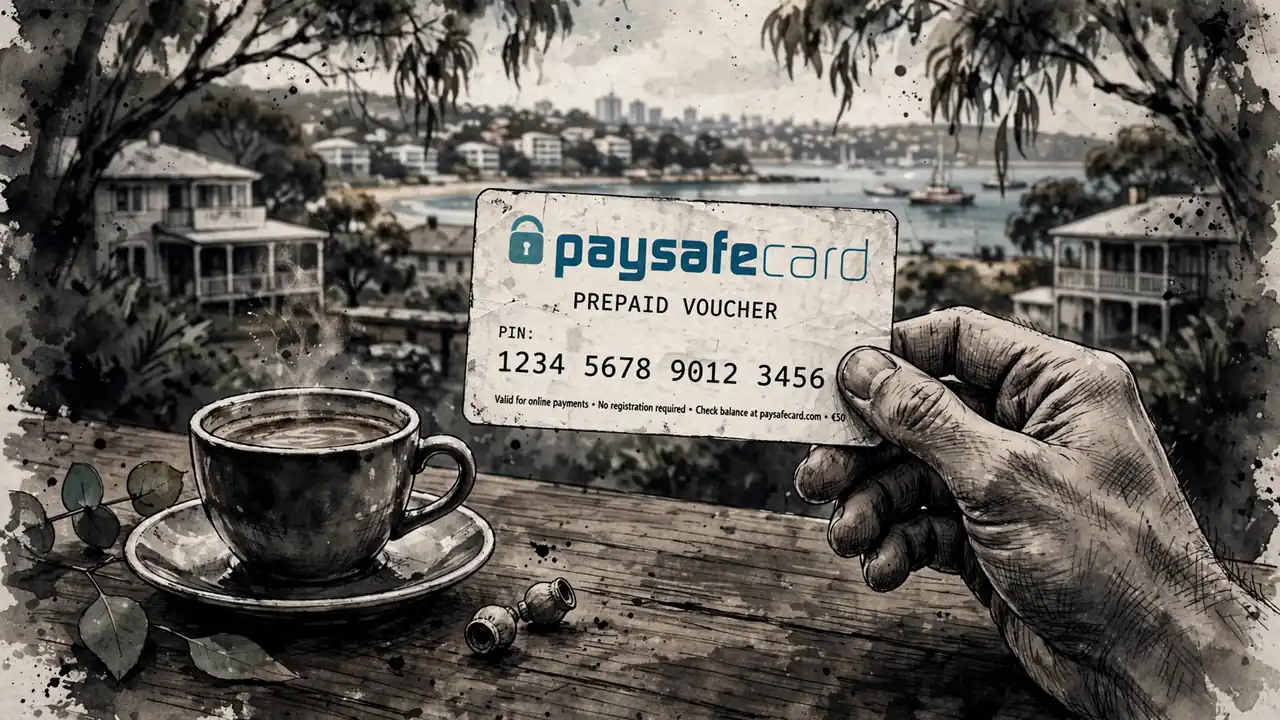
Paysafecard uses a 16-digit PIN. Its unused voucher funds may attract a small monthly maintenance fee if they remain unused for months. That condition belongs to the voucher balance, not to a credit-card account, and illustrates why “no card” does not mean “no payment rules.”
The underlying choice is therefore about the information and control attached to each route. A card deposit identifies a payment instrument connected to its issuer. POLi links the transaction to a bank account without exposing debit-card numbers to the casino. Vouchers substitute a purchased PIN and limit spending to the loaded value. Different paths, different records.
An online voucher product for the Australian market that allows fee-free deposits without sharing bank details.
Uses a 10-digit PIN for instant, deposit-only transactions without requiring bank credentials.
Works via a 16-digit PIN; unused funds may attract a small monthly maintenance fee.
At the counter, the clean distinction was always simple: a logo is a possibility; an active cashier method is a usable option. That is the difference.
Credit Card Casino Deposits: Timing, Fees and Account Checks
A credit card casino deposit is a transaction with three separate stages: the casino must display the method, the payment processor must route it, and the issuer must approve it. A card logo alone does not confirm that money will reach the balance. Once the route is available and approved, Visa and Mastercard deposits are widely accepted and are generally processed within seconds to minutes.
That speed applies to the transaction itself. It does not remove account checks. An online casino credit card deposit can remain pending, be reversed or become unusable if the account information does not match the payment details. The deposit may appear technically successful while the casino still restricts play until verification is complete.
When the deposit appears
The first practical check is the cashier status. A completed card payment should be reflected in the casino balance after processing, while a pending status indicates that the transaction has not cleared the payment route. The exact display varies by operator, but the distinction matters: “instant” describes the expected processing of an accepted Visa or Mastercard payment, not a guarantee that every issuer will approve it.
BPAY works differently. It does not require a separate account and operates as a payment gateway connected to a bank account. A specialist industry review reports that BPAY casino deposits can take a full day to finish processing and appear in the casino account. That is a statement about the route described in that review, not a universal processing rule for every operator.
This difference is easy to miss when comparing cashier buttons. A card deposit is presented as a direct card transaction; BPAY relies on a bank-linked payment flow and may therefore show a delay before the balance is updated.
Where fees can arise
BPAY transactions are free of charge, although a bank or credit card company may charge for additional services. The important distinction is between the payment method’s own charge and a separate fee imposed by a financial institution. A casino cashier may show no deposit fee while the account provider applies a charge under its own terms.
For Visa and Mastercard, the deposit screen should be checked before confirmation. A fee, if one applies, may be listed by the operator or payment processor rather than by the card network itself. Currency handling can also affect the final card statement when the transaction is not settled as an AUD deposit. No fee should be assumed merely because the payment page uses a familiar card logo.
Third-party payment charges should not be confused with operator charges at other stages. For instance, a specialist review states that Skrill withdrawals may carry a 1.45% operator fee, while Neteller fees can reach 2.5% at some operators. Those figures concern withdrawals, not a credit card casino deposit, so they should not be used to estimate the cost of funding an account.
Checks that can stop a usable deposit
The payment method must be in the same name as the casino account. A card issued to another person can therefore create a problem even when the transaction has been authorised by the issuer. The spelling on the AUD99 profile, bank account and identity document should match. If it does not, the operator can require clarification before allowing the deposited funds to be used or withdrawn.
Identity Verification KYC and age verification are mandatory; the operator may require identity documents or payment evidence before funds are accessible.
KYC checks are mandatory at every Australian online casino, with no workaround. Age is part of that control: gambling in Australia is restricted to people aged 18 and over. The operator may request identity documents or payment evidence, and the deposit is not a substitute for completing those checks.
A request to verify a card through an unfamiliar URL is another warning sign. Verification should stop if the link was not opened from the official site. Login details and one-time passwords should never be shared in chat, including with someone claiming to be support staff.
The useful test is therefore narrow: the card must be supported, the transaction must clear, the account and card names must match, and verification must be complete. Without all four, the fastest-looking deposit route can still leave the balance unavailable.
Other Payment Methods Used Alongside Credit Cards
A rejected card does not leave only one practical route. In Australian payment flows, the main alternatives are bank-linked services, vouchers and cryptocurrency. Each changes what information reaches the casino, how the transaction settles and what can happen later when funds need to move out.
PayID and BPAY
PayID is an instant, free payment method in AUD supported by most Australian banks. It settles through Australia’s New Payments Platform, so the transaction is connected to an existing bank account rather than a card network. For an online casino account, that can make PayID a straightforward substitute when a Visa, Mastercard or another card is not approved.
The trade-off is visibility. A bank-linked route does not provide the same separation as a voucher: the payment is associated with the account used to send the funds, and the casino may still require account verification before the balance can be used or withdrawn. The payment method must also match the casino account name.
BPAY follows a different process. It began as a bill-payment service connected to the traditional banking system and requires a generated Biller code and Customer Reference Number. There is no separate BPAY account to create; the transaction is initiated through banking facilities. The code and reference are not decorative details. A mistake in either can prevent the deposit from being allocated correctly.
A profile-focused review reports that BPAY casino deposits can take a full day to finish processing and appear in the account. That is a source-specific description, not a universal settlement rule. BPAY transactions themselves are free of charge, although a bank or card company may charge for additional services.
Vouchers for an Online Casino with No Card
Vouchers suit players who do not want to disclose bank account or card details to the casino. Flexepin was launched for the Australian market and allows fee-free casino deposits without sharing bank account details. The casino receives the voucher transaction, while the funding source remains outside the card route.
The limitation is operational rather than cosmetic: a voucher must be purchased and then accepted by the particular operator. It is not a general replacement for every banking function. A voucher can fund an account, but that does not automatically create a matching withdrawal route.
Neosurf works through a 10-digit PIN received when purchasing a voucher. Deposits are instant, generally deposit-only and do not require bank details to be shared. Spending is limited to the cash loaded on the voucher. Paysafecard uses a 16-digit PIN and may apply a small monthly maintenance fee when voucher funds remain unused for months. These products reduce the information passed during funding, but they add PIN management and provider-acceptance checks.
Crypto Settlement Cryptocurrency transactions are a separate settlement system. While they can be instant and private, they require absolute precision with wallet addresses and network selection to avoid irreversible errors.
Crypto as a Separate Route
Cryptocurrency can be used where the casino supports it, with deposits and withdrawals described as fast in a profile-focused review; that source states that withdrawals can take up to 24 hours when there is no network congestion. Crypto transactions can be instant, have zero conversion fees and offer enhanced privacy, but privacy is not the same as anonymity inside a verified casino account.
The operational risk is finality. A mistyped wallet address is irreversible, and sending Tether on the wrong chain may be unrecoverable. The route also requires the selected asset and network to match exactly. Crypto is therefore not simply an online casino using credit card alternative with a different button. It is a separate settlement system with its own error points, account checks and withdrawal conditions.
When an Online Casino Accepts a Credit Card but the Bank Does Not
A card can appear in the casino cashier and still fail before the transaction is approved. That distinction matters. The casino controls which payment brands it displays and which card transactions its processor is prepared to receive. The issuer controls whether the particular card may be used for that type of transaction.
Visa and Mastercard are widely accepted for casino deposits, but acceptance is not universal at the issuer level. American Express sits further from the mainstream route: fewer casinos support it, and its acceptance is less widespread than Visa or Mastercard. Therefore, an online casino accepting credit card payments may still reject an Amex deposit simply because the card network is not enabled for that cashier or processor.
The failure message often gives an unhelpful impression. A cashier may show “declined”, “bank declined” or a generic processing error. None of those messages proves that the casino does not accept cards. It may mean that the issuer refused the transaction after the casino had already presented it correctly.

Why Australian Amex deposits can fail
Australian-issued Amex credit cards may have gambling blocks enabled by default. Where that restriction applies, the issuer can stop a casino deposit even when the operator lists American Express as an available method. The blockage occurs at the banking stage, not because the casino has removed the card option.
This is why checking only the cashier can produce the wrong conclusion. The page may carry an Amex logo, accept the card details and submit the payment, while the issuer applies its own gambling control. The result is a failed deposit at a casino that does accept credit card payments in principle.
The same logic applies to a card-specific restriction. A bank may approve ordinary online purchases but decline gambling-related transactions. The merchant category and the card product can therefore matter as much as the balance or card number. A successful payment elsewhere is not evidence that the issuer will approve this one.
I have seen this treated as a “technical issue” because that wording is convenient. In practice, it often means the casino and the issuer are applying different rules.
Different approval layers.
American Express transactions do not carry issuer-level fees on deposits or withdrawals. That does not override a gambling block, and it does not make Amex as widely usable as Visa or Mastercard. A fee-free transaction can still be declined before any funds move.
The sensible reading of a failed attempt is therefore narrow: identify which side stopped it. If the cashier still lists Amex, the casino-side route may remain available; the issuer may be the actual refusal point. If the card brand is absent, the casino or its processor may not support that network at all. Those are separate outcomes and require separate explanations.
Understanding Rejections A declined transaction does not necessarily mean the casino refuses cards; it often means the issuer has blocked the specific payment.
Where a gambling block is active, repeated submissions are unlikely to change the result. The restriction belongs to the card issuer’s approval process, not to the wording used in the casino cashier.
A Casino That Takes Credit Cards Still Needs a Withdrawal Plan
A successful deposit at an online casino that takes credit card payments settles only the funding side of the account. It does not establish that winnings can be sent back to the same card. That distinction is easy to miss because the cashier presents Visa or Mastercard as one route, while the withdrawal department applies a separate set of processing rules.
Visa and Mastercard withdrawals typically take 1 to 5 business days. Even where the casino supports card payouts, the transaction may be rerouted to another available method. “Card accepted” describes the deposit channel, not necessarily the complete journey from deposit to cash-out.
From the operator’s side, rerouting is not automatically a payment failure. It can reflect how the card network handles incoming credits, the processor connected to the casino, or the casino’s own payout procedure. The balance may therefore need to leave through a bank transfer or an eWallet rather than returning directly to the card used for the AUD deposit.
That makes the withdrawal route part of the payment decision from the beginning. A card can be convenient for putting funds into the account, yet less useful when the account later has a withdrawal request. The important question is not simply whether a casino accepts credit cards. It is whether the available payout methods are workable as well.
Digital wallets and mobile payments
Skrill and Neteller withdrawals typically process within hours, with Skrill often under 24 hours. Those routes may therefore provide a different operational path from a card payout, although availability depends on the casino and the account’s permitted methods.
Apple Pay and Google Pay deposits are usually instant, but direct withdrawals through those services are rarely supported. They are typically rerouted through a card or bank transfer instead. A mobile wallet can streamline the deposit screen without changing the underlying payout mechanics.
I have seen the deposit method treated as the headline feature while the withdrawal route remained buried in the cashier terms. That is the wrong order of attention. Deposit first, payout second.
Real-Money Casino Deposits: Cards, Bank Routes and Crypto
A credit card casino deposit is real money only in the narrow account sense: once credited, it becomes part of the casino balance and can be used for eligible play. It is not cash in a bank account, and it is not automatically available for withdrawal. The balance remains subject to account verification, payment checks and any applicable bonus conditions. KYC is mandatory, and the payment method must be in the same name as the casino account.
That distinction matters when comparing an online casino real-money credit card deposit with a bank-linked route. Visa and Mastercard deposits are widely accepted and can be processed within seconds to minutes when the casino and issuer both support the transaction. A bank-linked option such as PayID moves AUD through Australia’s New Payments Platform, while POLi links directly to the player’s bank account without requiring a credit or debit card. These routes do not make the casino balance more withdrawable; they simply change how funds enter the account and what payment information is involved.
Crypto uses a different settlement model. Cryptocurrency transactions can be instant, have zero conversion fees and provide enhanced privacy, but the operational risk moves to the wallet and network details. A mistyped wallet address is irreversible, and sending Tether on the wrong chain may be unrecoverable. The account may show the deposit only after the relevant blockchain transaction is accepted.
How long do Visa or Mastercard withdrawals take?
Withdrawals typically take between 1 to 5 business days.
Are digital wallet deposits permanent?
While Apple Pay and Google Pay deposits are usually instant, direct withdrawals through these wallets are rarely supported and are typically rerouted.
Can I use a different name for my card?
No, the payment method must be held in the same name as the casino account to avoid ownership and verification problems.
A professional payment-method review describes crypto withdrawals as taking up to 24 hours when there is no network congestion. That is a route-specific observation, not a universal promise. The same caution applies to Bitcoin: a specialist banking overview places network fees at A$2–10 and notes that confirmations can take longer during congestion.
The practical comparison is therefore straightforward. Cards are familiar and often quick to credit. Bank routes connect directly to AUD banking infrastructure. Crypto can reduce payment disclosure but requires precision that a card transaction does not. None of these routes bypasses verification or guarantees a cash-out. Real money still remains controlled by the account’s checks and withdrawal rules.
Why Credit Card Cash-Outs Are Often Rerouted
A successful card deposit does not mean that an online casino payout to a credit card will follow the same route. Visa and Mastercard can be accepted for funding, yet the casino may be unable to return the balance directly to that card. The restriction is operational rather than necessarily a sign that the account or payment method is invalid.
Where a card cash-out is available, Visa and Mastercard withdrawals typically take 1 to 5 business days. The casino may first approve the request and then pass it through the card network, so the payment can involve more than one processing stage. In practice, the withdrawal page determines whether the card is eligible for the return transaction.
A reroute means that the casino sends the approved funds through another available channel. A bank transfer is the practical alternative when the operator needs to move money to an account rather than back through the card network. Bank transfers are described as the slowest option for Australian withdrawals, taking up to 7 business days.
An eWallet can be quicker where it is supported and verified. Skrill and Neteller withdrawals typically process within hours, with Skrill often under 24 hours. That faster processing applies to the eWallet route itself; it does not turn a card withdrawal into an instant payment.

From the account side, the important distinction is between approval and receipt. A withdrawal can be approved before the funds arrive, while a rerouted payment may have its own processing window. The original card remains relevant as a funding record, but it is not always the final destination.
That is why a credit-card cash-out should be assessed as a route, not a promise. Deposit accepted. Payout redirected.
What Makes a Credit Card Casino Payment Setup Work
A workable credit-card setup is more than a Visa or Mastercard logo beside the deposit button. The card network must be supported by the operator, the issuer must permit the transaction, and the casino account must pass its required checks. If one link fails, the payment route is not genuinely usable, however polished the cashier looks.
The first practical test is network compatibility. Visa and Mastercard are widely accepted for deposits, while American Express is supported by fewer casinos and may be blocked by Australian issuers when gambling restrictions apply. A “top credit card online casino” label means little unless the specific card type is accepted and the issuer will authorise the transaction.
Account details matter just as much. The payment method must be in the same name as the casino account, and identity checks are mandatory. The spelling on the profile, bank account and identification document should match. This is not decorative compliance. A mismatch can leave funds unusable until verification is completed.
The final test is the cash-out route. A successful card deposit does not guarantee that winnings can return to that card. Visa and Mastercard withdrawals may be rerouted, so the cashier should offer a practical alternative. PayID is an instant, free AUD payment method supported by most Australian banks and settled through Australia’s New Payments Platform. Bank transfer remains widely used for withdrawals, but it is described as the slowest route, taking up to seven business days.
That is the useful definition of a “top” credit-card casino: not the loudest claim, but a payment chain that survives authorisation, verification and withdrawal. If any stage depends on an assumption, the setup is incomplete.
No shortcuts. Just a functioning route.
Created by the ”Betting Guide AU” editorial team.