
Big Red Pokies Online Australia: How They Work
 Available in AU
A practical guide to reels, independent spins, RTP, volatility, free play and the limits of online pokies in Australia.

Table of Contents
- How Big Red Pokies Work: Reels, RTP and Volatility
- The Australian Legal Position on Online Pokies
- Playing Big Red Pokies for Real Money: What the Market Allows
- Free Big Red Pokies: Practice Without a Cash Stake
- How to Play Big Red Pokies Online Without Misreading the Interface
- Big Red Pokies Download Options: Browser Play Versus Installation
- Big Red Kangaroo Pokies and the Australian Theme
- Big Red Pokies Games: Reading the Game Label Carefully
- Big Red Demo Pokies: What a Test Spin Really Tells You
How Big Red Pokies Work: Reels, RTP and Volatility
Big Red pokies follow the same mathematical structure as other online pokies. The name, artwork and local terminology may change, but the underlying model still depends on reels, symbols, a random number generator, RTP and volatility. Understanding those terms matters more than the theme because the visual presentation does not alter how outcomes are produced.
Reels and independent spins
A spin begins when the selected stake is accepted and the game generates an outcome. The reels then display symbols that represent that result. In an online game, the reels are a visual presentation of the calculation rather than physical drums turning inside a cabinet. The displayed animation makes the result easier to follow, but it does not create the outcome.
Each spin on a pokie is independent. The previous result has no bearing on the next outcome. A win does not make another win more or less likely, and a sequence of losing spins does not build a debt that the game must repay. This is the point at which casual descriptions such as “due” or “hot” become misleading. They describe a player’s impression of a sequence, not a feature of the game’s mathematics.
The same principle applies to big red online pokies whether the session is played through a browser or another digital interface. Online pokies and slot machines use the same reels, RTP and volatility; the difference is mainly local terminology. In Australia, “pokies” is the established term, while “slots” is more common in international material. Neither label changes the mechanics.

The symbols shown on the reels are usually arranged around a paytable. That paytable explains which combinations qualify for a payout and how the game treats special symbols, where those features exist. The exact design belongs to the individual game. The important mechanical distinction is between the visible reel layout and the random process behind it: the animation is what is seen, while the generated result determines what is paid.
What RTP actually measures
RTP means Return to Player. It is a long-term theoretical average describing how much of the total stake a game is designed to return across a very large number of spins. It is not a promise for a particular spin, a single session or a particular punter.
A game’s RTP should therefore be read as a property of the model, not as a personal refund rate. If a short session produces no meaningful return, that does not contradict the stated RTP. The same is true when a short session produces an unusually large win. Short-term results can sit well above or below the theoretical average because individual outcomes remain separate.
This is where promotional language can hide an important qualification. “Return” sounds like money coming back on schedule. It is not. RTP does not specify when a win will appear, how many losing spins may occur first, or what result a future spin must produce. It describes a statistical expectation over the long run.

I have seen players treat RTP as if it were a session setting: stake a certain amount, receive the stated proportion, then stop. That is not how the measure works. The game does not track a personal balance against its theoretical percentage and correct the difference on the next spin. The calculation belongs to the game’s long-run design, not to an individual account.
Volatility: frequency versus size
Volatility describes the pattern of payouts. It is separate from RTP. Two games can have a similar long-term theoretical return while producing very different session experiences because their winning combinations are distributed differently.
High-variance pokies pay out less frequently but in larger amounts. A session may contain longer stretches without a win, followed by a more substantial payout when a qualifying combination appears. That does not make a large result more likely on the next spin; it describes the general shape of the game’s payout pattern.
Low-variance pokies pay out more often in smaller amounts. The screen may show winning combinations more regularly, but those wins are generally less substantial. Frequent small returns can feel smoother than infrequent larger ones, yet they do not turn the game into a predictable source of profit.
The terms “high” and “low” are descriptions, not guarantees. A high-variance game can produce several small wins, and a low-variance game can still produce an extended losing sequence. Volatility does not override independence. It gives context for the distribution of outcomes across a long run.
That distinction is easy to miss when the interface celebrates every win with sound, colour and movement. A small payout may look prominent even when it does not materially offset the stake. The display reports the event; it does not explain the broader relationship between stake, payout frequency and payout size.
Pays out less frequently but in larger amounts.
Pays out more often in smaller amounts.
Stakes do not alter the mathematics
Most online pokies allow bets ranging from a few cents to hundreds of dollars per spin. The available stake range depends on the individual game and platform, but changing the stake does not make a previous result relevant or persuade the random number generator to favour a particular outcome.
A larger stake increases the amount attached to the selected result. It does not create a mechanism for forcing a win, and betting the maximum does not guarantee a jackpot. Likewise, choosing a small stake does not improve the underlying odds. It changes financial exposure per spin, while the game’s reels, RTP and volatility remain the governing mechanics.
The practical vocabulary is therefore straightforward: reels show the outcome, independent spins prevent patterns from becoming predictions, RTP describes a long-term theoretical average, and volatility describes how often payouts tend to occur relative to their size.
Marketing calls it “big”. The maths stays the same.
The Australian Legal Position on Online Pokies
Australia’s online gambling framework is not built around a single national casino regulator. The main federal law for interactive gambling is the Interactive Gambling Act 2001 (IGA), supported by state and territory rules covering products that may be licensed locally. That distinction matters because a familiar game title does not determine whether its online supply is lawful.
Under the IGA, online casino games offered to Australians are prohibited interactive gambling services. That category includes online pokies, roulette, blackjack and live-dealer casino tables. Consequently, a real-money online casino cannot lawfully offer Big Red pokies to Australian residents as an Australian-facing casino product. The restriction concerns the provider’s conduct, not the name used for the game or the imagery associated with it.

There is no Australian casino licence for online pokies. The absence is structural, not a temporary gap in a public register: casino games cannot be licensed domestically for supply to Australians while that activity is prohibited under the IGA. A page using “licensed”, “regulated” or “Australian” in its marketing therefore cannot, by wording alone, turn an online pokie into a locally authorised product.
What the law targets
The IGA is directed primarily at gambling providers. Its enforcement framework targets operators that offer prohibited interactive services to people in Australia; Australian players are not prosecuted under the Act merely for placing bets. That does not create an Australian licence, consumer guarantee or domestic approval for the site involved. It simply separates provider liability from the position of the individual punter.
This is where promotional language can blur the legal line. “Big Red pokies for real money” describes a gambling activity, not a category approved by Australian regulators. The words “pokies” and “slots” indicate terminology or game type, but they do not prove legality, fairness, licensing or local protection.
Permitted products are different
Australia does permit certain forms of online gambling through relevant local licensing arrangements. Online sports betting is legal at state and territory level, and lotteries are also licensable. Those permissions do not extend to online casino games. A licence associated with one permitted gambling product cannot be treated as authority to provide pokies.
The practical conclusion is narrow but important: Australian law distinguishes sharply between licensed wagering or lottery products and prohibited online casino offerings. Big Red may be a game label, but it is not an exception to the Interactive Gambling Act 2001.
Australian Law Online casino games are prohibited for Australian residents under the Interactive Gambling Act 2001.
Playing Big Red Pokies for Real Money: What the Market Allows
“Big Red pokies real money” describes a playing situation, not an Australian licensing category. The game name may appear on an offshore casino, in a land-based venue, or in a free-play version, but the label itself says nothing about who operates the platform or which consumer protections apply. That distinction matters because Australian residents do not have access to a domestically licensed online casino offering real-money pokies.
The practical market is divided between legal local gambling products and offshore online casino services. Those two channels may look similar from a punter’s point of view, yet they do not have the same regulatory position.
Where real-money access actually sits
No Australian licence for online pokies has ever existed. An Australian-based operator therefore cannot lawfully offer online casino games, including pokies, to people in Australia. A page displaying a familiar game title does not change that position, and the word “pokies” is not evidence of local approval.
Offshore operators form the separate part of the market. Casinos based in Curaçao, Anjouan or similar jurisdictions may accept Australian residents and may list Big Red-style games for real-money play. Their licence, if stated, belongs to the jurisdiction that issued it; it is not an Australian casino licence. The operator’s location, licence status and account conditions remain separate questions from the game itself.
That is where promotional language can become slippery. “Australian-facing” may mean that the site accepts Australian registrations, shows Australian currency or provides local payment references. It does not mean that the casino is licensed in Australia. “Licensed” may refer to Curaçao, Anjouan or another offshore authority. Neither phrase should be read as a domestic endorsement.
From inside the industry, the important distinction is simple: availability is not the same as local authorisation. A game can be visible to an Australian resident without being part of Australia’s licensed online gambling system.

What an offshore listing does and does not establish
A real-money listing can establish that an operator is presenting the game for cash play. It cannot, by itself, establish fairness, legality for the provider, withdrawal performance or the existence of Australian consumer safeguards. Those points depend on the operator’s terms and the relevant offshore framework, not on the Big Red name.
The game title also does not establish payment support. A casino might display the title while offering different deposit or withdrawal methods, account restrictions or regional conditions. The same applies to claims about “instant” access or “safe” play. Those are operator statements requiring separate verification.
A licence number should be checked against the official register of the regulator that supposedly issued it. Malta Gaming Authority and Curaçao licensing authorities maintain public registers for this purpose. Australia’s ACMA publishes a register of Australian-licensed interactive wagering service providers, but that does not create an Australian register of online casino licences. There is no domestic casino licence to find.
That gap is often left unstated in advertising. The page shows a badge, a currency selector and a familiar game catalogue. The missing sentence is the useful one: this is offshore access, not an Australian-licensed online pokie.
Local alternatives for a cash stake
Australians still have legal ways to gamble locally, but they are not interchangeable with online casino play. Land-based casinos can offer casino products under the applicable state or territory arrangements. Licensed bookies can provide permitted sports and racing wagering, including pre-event markets. Lotteries are also licensed, and keno is among the permitted online gambling products.
These alternatives operate under different product rules. A licensed bookmaker is not an online pokie provider, and a lottery service is not an online casino. Treating every legal gambling website as evidence that online pokies are permitted would collapse separate categories that the regulatory system keeps apart.
- Check the official regulator register
- Verify the operator’s jurisdiction
- Rely on the game title for legal proof
- Assume “Australian-facing” means locally licensed
For anyone specifically looking for the Big Red game, the local alternatives do not reproduce the same online casino access. A land-based venue may provide electronic gaming machines, while wagering and lottery services offer different products altogether. The distinction is commercial as well as legal.
Free play versus a cash stake
Searches for “play Big Red pokies online free” or “Big Red pokies play free” often lead to a different product from real-money access. A no-stake version can display the game and allow spins without placing cash at risk, but it does not turn the title into a locally licensed online casino product. Free play and offshore cash play should therefore be kept separate when assessing an operator.
The next section deals with that no-stake format in detail. Here, the practical point is narrower: a free version may explain why a game attracts interest, while a real-money version introduces an offshore operator, account terms and financial exposure. The visual similarity between the two should not hide the difference in market position.
The same caution applies when a site places a free mode beside a deposit button. The shared interface can make the transition look routine. It is not routine from a regulatory standpoint. The free display is not proof that the cash service is locally authorised, and the cash service is not made Australian-licensed by offering a demo.
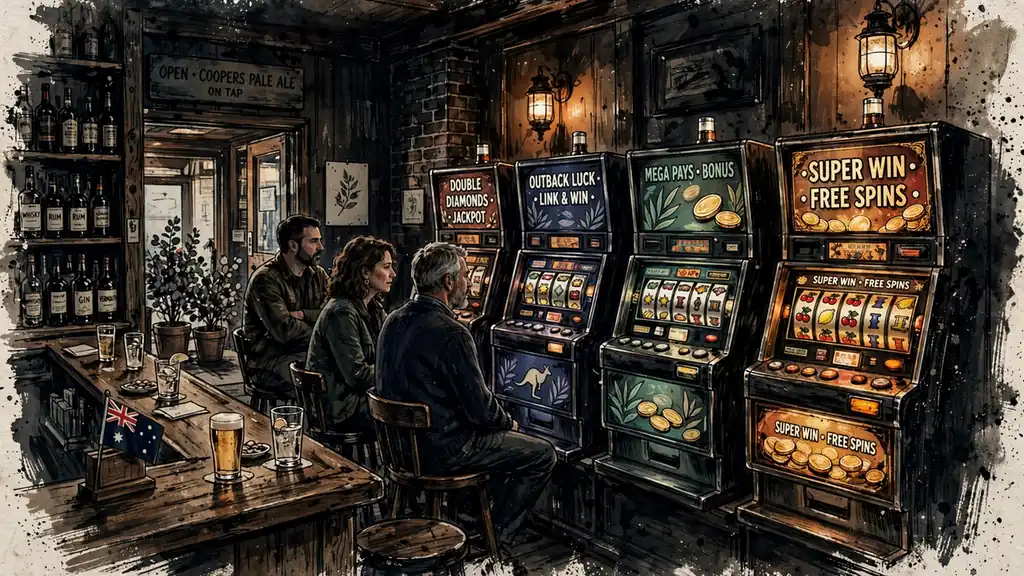
For this reason, “real money” should be read as a description of the stake, not a quality mark. Offshore access may be available to Australian residents, but availability alone does not supply domestic licensing or the protections associated with a locally authorised product. “Cash game” is two words. Different rules.
Free Big Red Pokies: Practice Without a Cash Stake
Free-play versions of Big Red pokies provide a way to explore the game without placing a cash stake. The reels, symbols and displayed controls can be examined in a low-pressure setting, which is useful when the interface is unfamiliar or when the aim is simply to understand how a title is presented. No deposit is required for a no-stake session, and no withdrawal process follows from its results.
That distinction matters. A free game can reproduce the visual structure of a real-money pokie, but it does not turn practice credits into cash. Any balance shown in the demo is part of the demonstration layer. It cannot be withdrawn, exchanged or treated as evidence of a real-money return.
What free Big Red pokies show
A free version can make several practical features easier to recognise:
- the number and arrangement of reels;
- the location of the spin control;
- the stake selector and displayed balance;
- the symbols used by the game;
- winning-line or win-display information;
- bonus features when the demo makes them available;
- the way the game records a result after each spin.
This is the useful part of big red free pokies. The session allows the game’s presentation to be inspected without confusing an unfamiliar control with a wagering decision. It can also show whether the pace, sound and visual effects are comfortable enough for continued play.
Free play is particularly useful for separating the game itself from promotional language. A label such as “feature-rich” may amount to a few animated screens and occasional prompts. A “simple” title may still have several symbol rules that need reading. The demo exposes what appears on the screen; it does not require accepting the wording used to market it.
From experience, the most revealing moment is often not a win. It is the pause before a spin, when the stake display, balance and result panel can be checked without pressure. If those elements are difficult to read in a free session, they will not become clearer when money is involved.
Demo Mode Free play versions are for inspection and practice only; demo credits cannot be withdrawn as cash.
What the demo balance does not mean
Demo credits are not a bankroll. They are not a forecast, a bonus or a reserve that can later be transferred. A large displayed balance after a short session says only that the simulated session produced those displayed results.
The same caution applies to a short run of losses. It does not show that the game is “due” to pay, and it does not create a reason to increase a future stake. Each spin on a pokie is independent. The previous result has no bearing on the next outcome.
That principle is easy to accept in theory and easy to forget when the screen produces a sequence of similar results. Free play can expose that emotional reaction without attaching it to a cash loss. A punter may see several non-winning spins and start looking for a pattern, or see repeated wins and assume the session has uncovered a reliable approach. Neither conclusion follows from the test.
No pattern. No correction.
RTP and short demo sessions
RTP, or Return to Player, is a long-term theoretical average. It describes the expected mathematical return across a sufficiently large number of game outcomes under the stated model. It does not promise that a particular free session will match that figure, and it says nothing certain about the result of a later cash session.
A short run can therefore look unusually generous or unusually harsh without contradicting the game’s published RTP. The displayed result is a small sample. The theoretical figure belongs to the game’s long-run mathematics, not to the temporary balance shown during practice.

This is where free online pokies can be misread. A demo may appear to “prove” that Big Red pays well because the test balance rises quickly. Another session may suggest the opposite because wins arrive less often. Both impressions can be real observations of that session and still be poor evidence about future outcomes.
The sensible use of a demo is narrower: observe the rules, inspect the presentation and understand the rhythm of the game. It is not a method for calculating a personal return.
High and low volatility in free play
Volatility describes how a game distributes its results. High-variance pokies tend to pay less frequently, with larger amounts when a winning result occurs. Low-variance pokies tend to produce wins more often, with smaller amounts.
A free session can make this difference feel more apparent, but it cannot remove the uncertainty. A high-variance game may produce a strong result early in the test, while a low-variance game may have a quiet stretch. The reverse can also happen. Short-term outcomes do not change the underlying classification.
The displayed win amount also needs context. A larger simulated win may be linked to the selected stake, a symbol combination or a feature event. It is not automatically evidence that the game is suitable for cash play. Likewise, frequent small wins do not establish that a session will remain stable.
The practical comparison is about style, not prediction:
| Volatility style | Typical pattern |
|---|---|
| High variance | Less frequent wins, potentially larger amounts |
| Low variance | More frequent wins, generally smaller amounts |
The table describes tendencies, not promises. A free test cannot guarantee that later outcomes will follow the same sequence.
A disciplined no-stake test
A useful session has a defined purpose. One test might examine the paytable and symbols. Another might focus on how the balance and win display react after each spin. A third might be used to compare the feel of a higher-variance title with a lower-variance one.
Keeping the purpose narrow helps prevent demo credits from becoming a pretend gambling budget. There is no reason to chase a simulated loss, protect a simulated profit or celebrate a balance that has no cash value. The exercise ends when the mechanics are understood.
Free Big Red pokies are therefore best treated as an inspection tool. They can show the game’s visible structure, demonstrate its result display and provide a risk-free setting for learning the interface. They cannot predict the next spin, convert theoretical RTP into a personal guarantee or establish that a particular volatility profile will produce a desired outcome. Those limits are not a defect in free play. They are the boundary between practice and wagering.
How to Play Big Red Pokies Online Without Misreading the Interface
Playing Big Red pokies online follows a simple sequence, but the screen can make that sequence look more complicated than it is. The familiar elements remain: reels, symbols, a stake control, a spin button and a display for wins or credits. The main difference is that the physical cabinet has been replaced by a browser interface or game window.
That change matters because online labels are sometimes written for a global audience. “Spin”, “bet”, “lines” and “balance” may appear where an Australian venue would use more familiar pokies language. The terminology changes; the underlying game does not. Online pokies and traditional slot machines use the same reels, RTP and volatility. The distinction is local wording, not a different mathematical model.
Reading the main controls
Before a spin, the interface generally presents the controls that determine the stake and start the game. The balance shows the available funds or, in a no-stake version, the credits assigned to the session. The bet control sets the amount committed to the next spin. A separate button then starts the reels.

The important distinction is between the selected stake and the result. Changing the stake changes how much is committed to that spin. It does not tell the reels which symbols will appear, and it does not turn a losing sequence into a favourable one. Labels such as “total bet” or “coin value” should be read carefully because a displayed amount may combine several settings.
Paylines, ways to win or symbol information are usually available through a help, information or menu button. That panel explains which combinations count and whether special symbols have particular functions. It is part of the game rules, not a prediction tool. A paytable can show what a winning arrangement means; it cannot show when that arrangement will occur.
Following one spin
A clear way to understand the interface is to follow a single round:
- The stake is selected using the bet controls.
- The spin command is pressed.
- The reels animate and stop in the game’s displayed order.
- The result is evaluated against the rules shown in the information panel.
- Any win, updated balance or remaining credit is displayed.
The animation is presentation. It gives the round a visible beginning and end, but the movement of the symbols should not be treated as a physical process that can be influenced by timing. Rapid stops, repeated clicks or watching the reels closely do not create control over the outcome.
Some interfaces include autoplay, turbo mode or an option to skip animation. Those settings alter how the round is displayed or repeated. They do not alter the basic relationship between stake, reels and outcome. Autoplay is therefore an operating feature, not a strategy.
Why previous spins are not a system
The most persistent interface mistake is reading the recent-results panel as if it were a forecast. A run of losing symbols can look like a win is “due”, while several wins can create the impression that the game is temporarily generous. Neither interpretation follows from the mechanics.
Each spin is independent. The previous result has no bearing on the next outcome. A history panel records what has already happened; it does not communicate what the random number generator will produce next. The same applies to streaks, near misses and repeated symbols. They may be visually persuasive, but they do not create a usable sequence.
Interface Perception Attention Visual animations and recent result histories do not influence the mathematical outcome of the next spin.
I have seen this confusion grow when the interface highlights wins in bright colours or lists recent outcomes beside the reels. The design encourages attention to patterns because patterns keep the screen readable and engaging. It does not convert random results into information about the next spin.
The practical rule is short: read the controls, then ignore the superstition.
Big Red Pokies Download Options: Browser Play Versus Installation
A search for a Big Red pokies download can describe two different things: opening the game through a browser, or installing software on a phone or computer. Those routes may change how the title is accessed, but they do not create a different game model. The reels, RTP and volatility belong to the game itself, not to the icon used to launch it.
Browser-based access
Browser play loads the game through a website without placing a separate package on the device. This can be useful when the title is available in a mobile-friendly format, because access depends on the browser interface rather than a dedicated application. The visible controls, reel layout and sound may be adjusted for a smaller screen, while the underlying mechanics remain the same.
There is also less ambiguity about what has been installed: nothing beyond the normal browser session. A page can still display a game branded as Big Red, but the label alone does not establish who operates the platform, what protections apply, or whether the game is being offered through an Australian-licensed casino. The name identifies a themed title, not a regulatory status.
Access Methods
Browser Play
Games are loaded via a website without installing software on your device.
Installed Apps
Software is placed directly on your device via a downloadable package.
Installed apps and game packages
An installed app is different from browser play because software is placed on the device. In some cases, an operator’s app acts mainly as a wrapper around its web platform. In others, a downloadable game package may contain the interface and supporting files needed to run the title. Neither description, by itself, proves that the download is official or that the product is suitable for a particular market.
The practical checks are straightforward: confirm the source, review the permissions requested by the app, and avoid files distributed through unknown channels. A genuine-looking logo is not evidence of authenticity. Nor does installation alter the reels or turn a standard pokies title into a separate version with better outcomes.
What a download cannot change
For platforms presenting themselves as licensed and Australian-facing, random outcomes are required to come from independently audited random number generators. That requirement concerns the game system, not whether the title opens in Safari, Chrome or an installed application.
I have seen “download” used as a reassuring word in promotional copy. In practice, it can mean little more than a shortcut to a browser page. The file matters less than the source behind it. Same reels. Same mathematics. Different doorway.
Big Red Kangaroo Pokies and the Australian Theme
This page highlights operators associated with Big Red pokies for Australian players in 2026. Use the concise verdicts to review the available licensing, bonuses, payment details, and minimum deposit information.
License: Curacao eGaming Licence · Min. deposit: A$10 Aussie Play is listed with a Curacao eGaming Licence and a minimum deposit of A$10. It may suit players looking for a low-entry option with stated licensing information.
License: Tobique Gaming Commission · Bonus: up to A$8,000 + 400 free spins across 4 deposits · Payout speed: crypto ~10-15 minutes, fiat 1-5 days · Min. deposit: A$30 SkyCrown stands out for a bonus of up to A$8,000 plus 400 free spins across four deposits. It also lists crypto payouts at around 10–15 minutes, fiat payouts in 1–5 days, a Tobique Gaming Commission licence, and a A$30 minimum deposit.
Bonus: up to A$6,600 + up to 250 free spins across 4 deposits DragonSlots Casino is notable for a bonus of up to A$6,600 and up to 250 free spins across four deposits. This is the main stated feature available for this operator.
License: Curacao (operating since 2017) · Bonus: 250% up to A$2,000 + 50 free spins on the first of six deposits · Min. deposit: A$20 Uptown Pokies operates under Curacao and has been operating since 2017. Its first of six deposits carries a 250% bonus up to A$2,000 plus 50 free spins, with a A$20 minimum deposit.
License: Curacao eGaming (Roby Games Ltd) · Bonus: 100% up to A$750 + 200 free spins Roby Casino is associated with Curacao eGaming through Roby Games Ltd. Its listed offer is a 100% bonus up to A$750 plus 200 free spins.
License: Curacao eGaming Licence · Min. deposit: A$10 King Billy is listed with a Curacao eGaming Licence and a minimum deposit of A$10. These are the key stated details for assessing its entry requirements and licensing.
License: Curacao eGaming OGL/2023/174/0082 (Dama N.V.) · Bonus: up to A$10,000 + 500 free spins across 4 deposits · Min. deposit: A$15 LevelUp Casino lists a Curacao eGaming OGL/2023/174/0082 licence held by Dama N.V. Its offer can reach A$10,000 plus 500 free spins across four deposits, with a A$15 minimum deposit.
License: Curacao · Bonus: 100% up to A$500 + 200 free spins, 10x wagering · Payout speed: crypto 30-60 minutes, fiat 1-5 days · Min. deposit: A$10 Wild Tokyo lists a Curacao licence, a A$10 minimum deposit, and a 100% bonus up to A$500 plus 200 free spins with 10x wagering. Payouts are stated as 30–60 minutes for crypto and 1–5 days for fiat.
Bonus: 100% up to A$750 + 200 free spins, 35x wagering · Payout speed: crypto 30-120 minutes, fiat 24-72 hours · Min. deposit: A$30 MrPacho offers a 100% bonus up to A$750 plus 200 free spins, with 35x wagering. Its listed minimum deposit is A$30, while payouts are stated as 30–120 minutes for crypto and 24–72 hours for fiat.
License: Curacao Gaming Control Board · Bonus: up to A$5,000 + 400 free spins JustCasino is listed with a Curacao Gaming Control Board licence. Its stated promotion is up to A$5,000 plus 400 free spins.
The phrase “Big Red Kangaroo” points to a theme before it says anything about the operator behind the game. Its imagery is recognisably Australian: red earth, native wildlife and the familiar kangaroo motif used to create an unmistakable local setting. That identity can make a pokie feel more relevant to Australian audiences, but the artwork remains a design choice, not evidence of origin, approval or player protection.
In practical terms, a Big Red Kangaroo pokie follows the same underlying model as other online pokies. The reels display symbols, a random number generator determines each spin, and the game is described through its RTP and volatility. Those features do not change merely because the title uses Australian imagery. “Kangaroo” is the visual language; it is not a separate technical category.
What the theme communicates
A red kangaroo is an efficient symbol for a game studio. It establishes place without requiring a long explanation, while colours associated with the outback give the interface a clear visual direction. Promotional material may also use phrases such as “Australian adventure” or “native wildlife” to make the title sound distinctive. Those expressions describe presentation, not the conditions under which the game is supplied.
The label can therefore help identify the intended atmosphere:
- Australian wildlife and outback imagery
- A red-and-earth-toned visual style
- A pokie designed around a regional theme
- Familiar terminology for an Australian audience
It cannot, by itself, establish who made the game, where it was developed, whether an operator is trustworthy, or whether Australian consumer protections apply.
Pokies terminology and game identity
“Pokies” is the natural Australian term for this type of game. International descriptions may call the same product a slot or slot machine, but the mechanical distinction is not real. Online pokies and slot machines use the same reels, RTP and volatility; the main difference is local terminology.
That matters when a themed title appears in several catalogues under slightly different wording. “Big Red Kangaroo,” “Big Red Kangaroo pokie” and a broader Big Red label may refer to related branding, a specific title or a category description. The name should be treated as an identifier to compare, not as a guarantee that every listing represents the same release.
The Australian setting also needs to be kept separate from licensing. No Australian licence for online pokies has ever existed. A kangaroo on the screen does not turn an offshore product into a locally licensed one, and the word “pokies” does not add protections that the supplying platform does not actually provide. Theme first, mechanics second, operator details separately. That order prevents the artwork from doing more persuasive work than it deserves.

Big Red Pokies Games: Reading the Game Label Carefully
A listing for Big Red pokies games usually tells less than its wording suggests. It may identify a themed game, a group of related titles, or a page built around Australian-style terminology. It does not, by itself, identify the operator behind the page, the software supplier, or the regulatory status of the service hosting it.
That distinction matters because a game label belongs to the product description. An operator is a separate business with its own terms, controls and legal position. Treating the two as one is how promotional copy quietly does the work of verification.
What the label can indicate
“Big Red” may function as a title, a brand-style phrase, or a theme reference. “Pokies” signals the terminology used for gaming machines in Australia. “Games” suggests a collection or category rather than a specific title. None of those words is a technical certification.
Is Big Red legal in Australia?
No, online casino games are prohibited under the Interactive Gambling Act 2001.
Can I win real money with a demo account?
No, demo credits are part of a demonstration layer and cannot be exchanged for cash.
Online pokies and land-based slot machines use the same underlying categories of game information: reels, RTP and volatility. The local word changes; the core model does not. A page using “pokies” is therefore not automatically describing a distinct Australian game format. It may simply be presenting familiar casino content in language suited to the local audience.
A more useful label should identify the actual title and, where available, the software provider. Names such as Aristocrat, Big Time Gaming, NetEnt or Pragmatic Play can help distinguish a game from a generic catalogue heading. Even then, the provider name describes the software, not the legal status of the website displaying it.
What the label cannot prove
A page called Big Red pokies games does not prove that the operator holds an Australian casino licence. No Australian licence for online pokies exists, and none has ever existed. Nor does the word “Australian” establish local approval, Australian consumer protection or a connection with a land-based venue.
The same caution applies to claims such as “official”, “licensed” or “trusted”. Those are promotional descriptions until supported by a relevant licence and identifiable operator information. A game title cannot supply that evidence.
From my time checking gaming menus, the practical rule was simple: separate the label from the venue. First establish what game is being described. Then assess who is offering it and under which jurisdiction. Mixing those questions allows attractive naming to stand in for facts. It should not.

Big Red Demo Pokies: What a Test Spin Really Tells You
A demo version of a Big Red pokie is best treated as an observation tool, not a forecast. It can show how the game presents its reels, symbols, win messages and feature sequence without placing a cash stake. That makes a test session useful for understanding the machine’s behaviour on screen. It does not turn a random game into a predictable one.
The central point is simple: every spin is independent. A result seen during a demo session has no bearing on the next spin, whether the previous outcome was a win, a loss or a long sequence without a feature. The interface may display recent results, but that history is information about what has already happened, not a signal about what comes next.
What demo play can reveal
A short session can help identify the practical character of the game:
- whether the reels are easy to follow;
- how winning combinations are displayed;
- how bonus features are introduced;
- whether the pace and visual effects are comfortable to watch;
- whether the game appears more suited to frequent small returns or less frequent larger ones.
The last point relates to volatility. High-volatility pokies tend to pay less frequently, with larger amounts when wins occur. Low-volatility pokies tend to produce wins more often, but in smaller amounts. A demo session may give an impression of this pattern, but a brief run cannot establish it conclusively. Random outcomes can make a high-volatility game look active for a while, or make a low-volatility game appear unusually quiet.
RTP is not a session promise
RTP, or Return to Player, describes a long-term theoretical average. It is a mathematical property of the game over a very large number of spins, not a target that must appear during one test session. A demo run can finish above or below that theoretical level without contradicting the stated RTP.
This distinction is where promotional language often becomes slippery. “Proven returns” may describe a long-run calculation while sounding like a near-term expectation. The calculation remains theoretical. It cannot guarantee the result of one spin, one evening or one short sequence in demo mode.
I have seen short sessions create strong impressions precisely because the eye gives memorable wins more weight than ordinary losing spins. That reaction is understandable, but it is not evidence of a changing game pattern.
A sensible use of the test
Demo play has a narrow but useful purpose: checking whether the game’s presentation and volatility profile fit the intended style of play. It can clarify what the screen communicates and how a feature is represented. It cannot prove that a future cash session will repeat the same results, improve after losses or reward continued spinning.
The clean reading is this: a demo shows possible outcomes, not promised outcomes. The reels reveal the game. They do not reveal the future.
Created by the ”Betting Guide AU” editorial team.